

AI Agents vs Agentic AI: Key Strategic Insights

In the rapidly evolving landscape of artificial intelligence, terminology often struggles to keep pace with innovation. Two terms at the center of architectural debates are AI Agents and Agentic AI. Though they sound similar, they represent fundamentally different approaches to designing, deploying, and governing intelligent systems. Understanding the difference is critical for organizations planning their AI strategies.
1. AI Agents: Task-Oriented Specialists
An AI Agent is a specialized component designed to execute a specific, well-defined task. Think of it as a sophisticated tool operating within a human-directed workflow.
How they work:
-
Operate within predefined workflows: “If X happens, the AI Agent does Y.”
-
Depend on external logic; they don’t decide what to do beyond their instructions.
Architecture:
-
Typically stateless — they do not retain memory of past interactions.
-
Require orchestration by humans or external systems to determine their next action.
Best Use Cases:
-
High-efficiency automation of stable, repetitive processes: customer service chatbots, automated data extraction, or code completion.
Key Trait: Execution efficiency. AI Agents excel when tasks are predictable and rules are clear.
2. Agentic AI: Goal-Driven Systems
Agentic AI represents a paradigm shift: instead of following instructions, the system pursues objectives autonomously. It is a system-level capability rather than a single component.
How they work:
-
You provide a high-level goal (e.g., “Optimize this supply chain”).
-
The system internally plans, selects tools, adapts to obstacles, and adjusts its course.
-
Operates through decision loops rather than linear task execution.
Architecture:
-
Persistent memory and reasoning layers allow the system to remember past interactions and learn over time.
-
Can coordinate multiple specialized AI Agents to achieve complex outcomes.
Best Use Cases:
-
Dynamic environments with unpredictable changes: complex medical diagnostics, autonomous operations, or strategic financial planning.
Key Trait: Adaptive problem-solving. Agentic AI thrives where ambiguity and change are the norm.
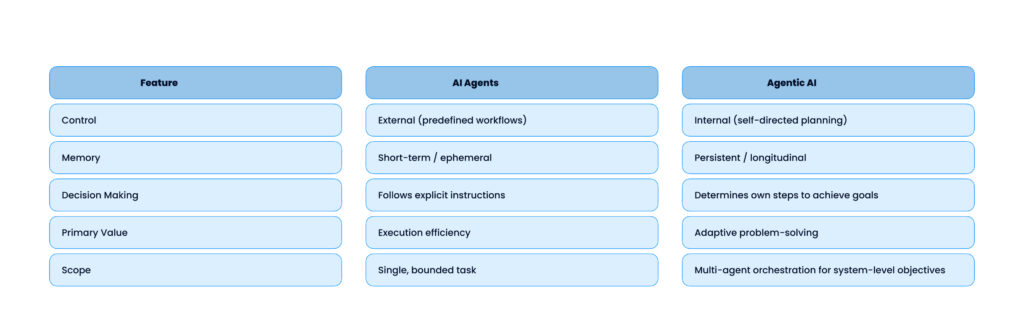
3. Core Differences Between AI Agents and Agentic AI
Summary of the Diagram
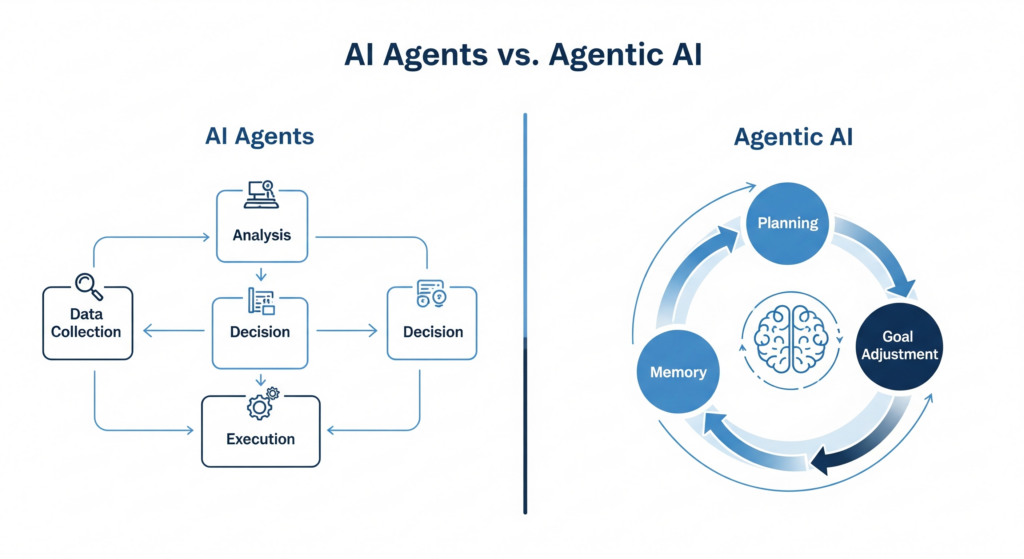
Left (AI Agents): Shows a linear, task-based workflow. Each step—data collection, analysis, decision, and execution—is controlled externally, highlighting the AI’s role as a specialized tool within a human-directed process.
Right (Agentic AI): Illustrates a circular, goal-driven loop. The system continuously plans, remembers, and adjusts its objectives, demonstrating its ability to operate autonomously and adaptively in dynamic environments.
Key Takeaway: While AI Agents are reactive and stepwise, Agentic AI is proactive, self-directed, and capable of orchestrating complex tasks over time.
4. Why Adopting AI Agents and Agentic AI is Essential
In modern enterprises, the AI landscape is no longer about “if” to adopt AI, but how to adopt it intelligently. Using AI Agents and Agentic AI strategically is essential for several reasons:
-
Accelerate Operational Efficiency – Automate repetitive tasks, freeing human employees for higher-value work.
-
Enable Strategic Agility – Respond proactively to dynamic conditions through goal-driven planning.
-
Reduce Human Error – Minimize mistakes in both routine and complex tasks.
-
Future-Proof the Enterprise – Build hybrid systems that combine precision with adaptability.
-
Support Governance and Accountability – Implement traceable reasoning, human-in-the-loop safeguards, and outcome attribution.
In short: Combining AI Agents and Agentic AI balances immediate efficiency with long-term adaptability, reducing risk and positioning organizations to thrive in complex environments.
5. Strategic Implications
Choosing between AI Agents and Agentic AI is not about “better or worse”—it’s about fit and purpose:
-
AI Agents provide immediate ROI through automation of clear-cut tasks.
-
Agentic AI provides long-term resilience, allowing software to handle ambiguity and evolve with the business.
The most effective enterprise architectures will likely be hybrid: a layer of Agentic AI orchestrating a fleet of specialized AI Agents, combining autonomy with precision.
6. Governance Frontier: Enabling Safe Autonomy
Agentic AI unlocks unprecedented autonomy and adaptability—but with this power comes the opportunity to design robust governance systems that make it safe, accountable, and effective.
Key practices for leveraging Agentic AI responsibly include:
-
Traceable Reasoning: Maintain clear logs of the system’s internal decision-making, so insights and outcomes are fully auditable.
-
Human-in-the-Loop Guardrails: Empower the system to act independently while allowing humans to approve critical decisions.
-
Outcome Attribution: Clearly define responsibility when multiple agents work together to achieve complex results.
With these practices, organizations can confidently delegate autonomy, turning Agentic AI into a strategic advantage. The future of intelligent software will not be limited by model complexity—but by how effectively we combine autonomy with governance to achieve scalable, reliable outcomes.
7. Visualizing the Difference
AI Agents: Linear, task-based flows where humans orchestrate each step.
Agentic AI: Circular, goal-driven loops where the system plans, acts, and adapts continuously.
This visualization highlights the contrast: AI Agents respond; Agentic AI strategizes. Together, they form a complementary, high-performing ecosystem.
Conclusion: Understanding the difference between AI Agents and Agentic AI is essential. One excels at precision and speed, the other at adaptation and autonomy. Organizations that adopt both intelligently are best positioned to maximize efficiency, mitigate risk, and remain agile in a rapidly changing world.